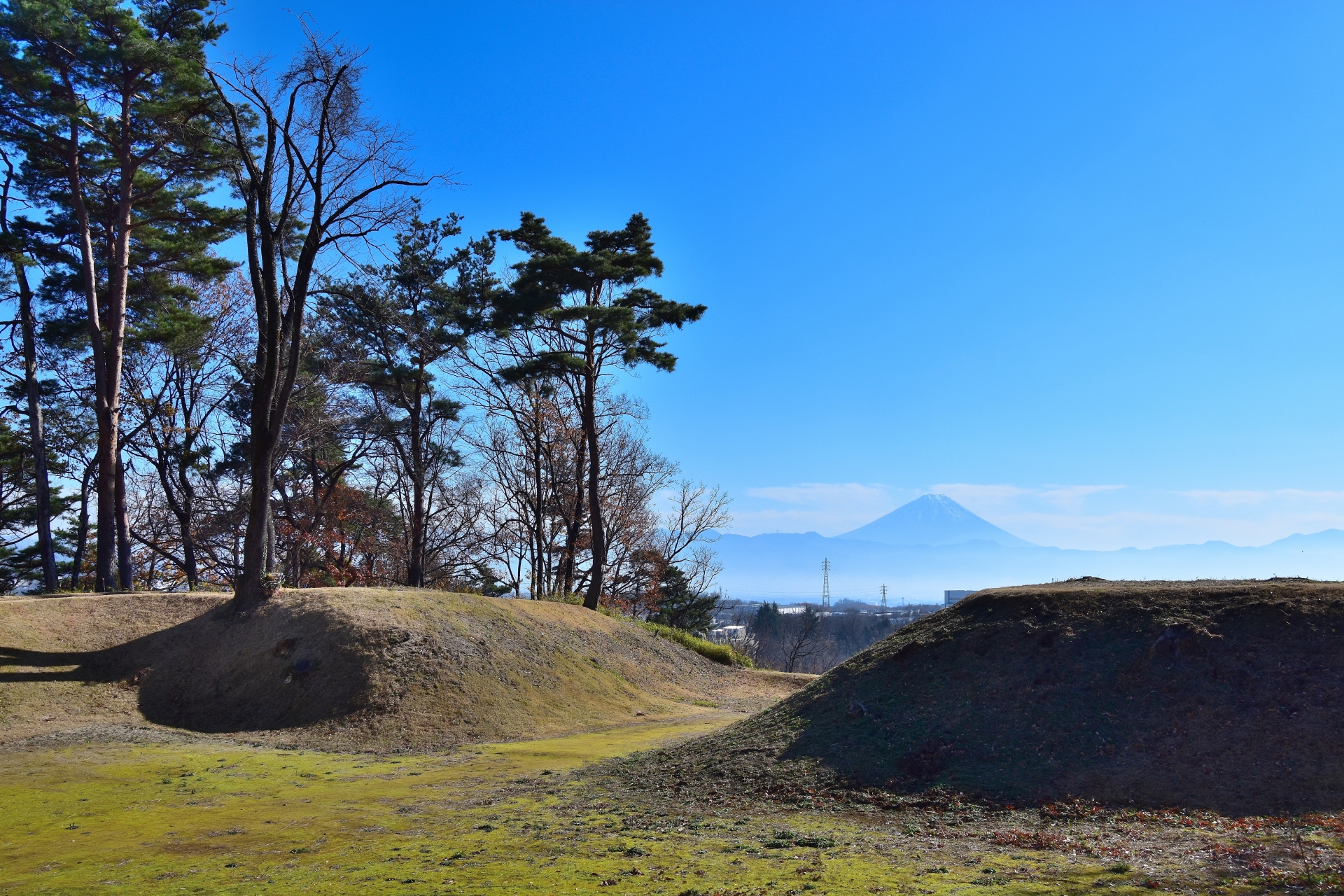
A castle ruin is a good place to be alone with history. The trail is compact and easy to follow without a map. On quiet weekdays, you may have the hill entirely to yourself. Walk slowly. Read the signs. Let the weight of what happened here settle.
No keep. No stone walls. No souvenir shops, no tour buses, no crowds.
Shinpu Castle burned to the ground 68 days after its lord moved in. That was 1582. What remains is a forested hill, a set of earthwork ramparts, a quiet Shinto shrine on the slope — and one of the most affecting sites in Yamanashi for anyone who cares about Japanese history.
The 68-day castle
Takeda Katsuyori, son of the legendary Takeda Shingen, built Shinpu Castle in 1581 as a new base of operations. It was a serious construction: an earthwork fortress using techniques unique to the Takeda clan, designed to resist the firearms-based warfare that was changing Japan.
He moved in on January 3, 1582.
On March 11, Oda Nobunaga’s army crossed into Takeda territory. The Takeda forces, depleted by years of war, collapsed almost immediately. Katsuyori set fire to Shinpu Castle himself and fled north. Sixty-eight days after the gate first opened, the castle was ash.
Two weeks later, Katsuyori died at Tenmokuzan. The Takeda clan — which had been one of the most powerful in Japan for two generations — ceased to exist.
Shinpu Castle is where it ended.
Why it’s on the 200 Castles list
Japan’s Continued 100 Famous Castles designation goes to sites of historical significance, not necessarily scenic grandeur. Shinpu Castle earned its place because the earthwork ramparts (dorui) and moat structures are unusually well-preserved — you can read the layout of the original fortification just by walking the hill. For castle specialists, it’s a rare example of a pure earthwork castle at this level of integrity.
For everyone else, it’s a peaceful wooded hill with a clear historical story and almost no other visitors.
Two ways to walk it
The forest trail (30–40 minutes): A gentle path through the trees, following the earthworks around to the main compound. Unpaved — wear comfortable shoes. You’ll arrive at the honmaru (main enclosure) without quite noticing the climb.
The stone steps (direct): 250 steps up through the torii gates of Fujitake Shrine, the Shinto shrine that Katsuyori himself dedicated when the castle was built. The red torii gates against green forest have a particular gravity. It’s a climb, but a meaningful one.
Both routes lead to the same place. The views from the top — across the valley toward the Southern Alps — are worth either approach.
Spring: when the peach orchards bloom
In early to mid-April, the area around Shinpu Castle transforms into what locals call the Shinfu Peach Blossom Village: approximately 60 hectares of peach orchards in full pink bloom, with cherry trees flowering simultaneously on the castle hill itself.
The Southern Alps rise behind it all.
It is, without exaggeration, one of the most beautiful things in Yamanashi. And because most spring visitors head to the more famous viewing points, this particular corner is never overwhelmed.
The castle stamp
Shinpu Castle’s official stamp and goshuin (commemorative seal) are not available at the site itself. They’re issued at the Nirasaki City Folklore Museum, about 5 minutes by car from the castle. Entry is free. The stamp can be collected outside opening hours (a pre-stamped sheet is kept at the entrance). The goshuin costs ¥300.
If you’re collecting stamps from the Continued 100 Famous Castles, this is one to add.
Getting There
By Car: ~10 minutes from Nirasaki IC on the Chuo Expressway. Free parking on-site. Note: crossing a busy road between the parking lot and castle entrance — take care. By Train: ~20 minutes on foot from JR Shinfu Station (Chuo Main Line). Trains are infrequent — check the timetable. Castle stamp & goshuin: Available at Nirasaki City Folklore Museum, approximately 5 minutes by car from the site. Free entry.